Television as an alternative reality
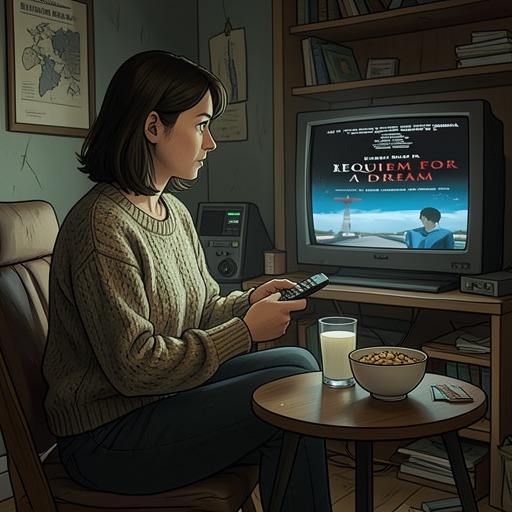
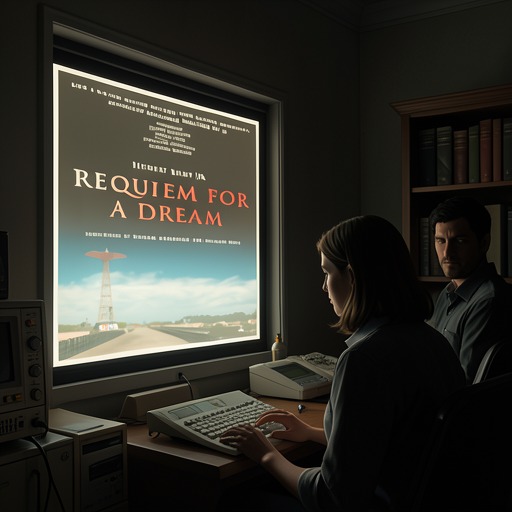
Requiem for a DreamTelevision as an alternative reality is the changing role of the screen in Sara Goldfarb’s life: it begins as a fiercely protected household possession, supplies ready-made pictures of happiness and recovery, and eventually becomes the setting for both her imagined public triumph and her terror of public shame. As the boundary between broadcast images and lived experience weakens, television offers Sara a future to inhabit while making her increasingly vulnerable to the gap between that future and her actual circumstances.
A Possession and a Point of Conflict
The television is not an incidental appliance in Sara’s apartment. When Harry Goldfarb removes it, Sara chains the set to a radiator, turning her attachment to television into a physical obstacle to his taking it. Harry discovers the chain only after the set jerks and nearly falls. He treats the restraint as an accusation designed to make him feel guilty, while Sara remains silent in the closet. After he unlocks the chain and pushes the set out, she sits with her eyes closed and rocks, insisting inwardly that the loss is not happening. She imagines the interruption as a commercial break after which the program will return and everything will be made right. Television’s rhythms already shape how she tries to endure an event in her own home.
The scene also establishes the unequal meanings the set holds for mother and son. Harry sees an object he can remove and a conflict he wants to escape; Sara sees a source of company and continuity. Her confidence that the television will return is less a practical expectation than a means of preserving the world she associates with it. When she later gets the set back, she chains it to the radiator again, making her need for it visible in the room itself.
Broadcast Domesticity and Reassuring Endings
While watching commercials and a soap opera, Sara responds to television as though its small domestic images were lessons about health, family, and a desirable life. She watches people brush their teeth and examines the image of a healthy child through her concern for Harry, whom she thinks too thin. Advertisements show sparkling floors, clean clothes, a tired husband delighted by his home, and a thin, sweet-looking wife. Sara connects these scenes to her hope that Harry will find a nice young Jewish woman and settle down. Television does not merely distract her; it supplies a recognizable script for the family future she wants.
The set’s dinner scene makes the boundary between representation and ordinary life more complicated. Sara watches a happy couple eat television dinners and share an affectionate look. She knows the meal came from a package, but joins the scene’s pleasant illusion, smiling without revealing the truth. After checking her money, she realizes that keeping the television means going without lunch for several days. The sacrifice is concrete; the domestic happiness on-screen is not. Her willingness to pay for continued viewing shows how the set’s imagined comforts can outweigh immediate needs.
A televised medical drama offers an even more complete promise of resolution. Sara watches a worried mother hear the risks of an operation for her son and urges her, in her thoughts, to let the doctor proceed. She imagines the boy surviving, leaving the hospital, and returning home with his mother. The program has not shown this happy outcome, but Sara anticipates it with confidence and transfers that confidence to Harry: he is mischievous, she believes, but good, and everything will be all right. The television’s narrative closure becomes a template for the ending she hopes life will provide.
From Viewer to Imagined Contestant
The decisive change begins with a real telephone call. As Sara adjusts the antenna to remove lines from the picture, she struggles to hear the ringing phone. The caller, Lyle Russel of McDick Corporation, speaks with the brightness and enthusiasm of a television announcer; Sara keeps looking between the phone and the set, at first seeming unsure where the voice is coming from. He tells her she may be a contestant on a quiz show, including a new program planned for the next season. The invitation is real, but its arrival through a voice that sounds like television lets her viewing world and future life join together.
After the call, Sara imagines what appearing on television will require. She worries about a dress, a girdle, and losing thirty pounds, considers asking Ada to fix her hair, and lists shoes, a handbag, earrings, a necklace, and a handkerchief. She first thinks of the red dress she wore for Harry’s bar mitzvah, then decides red may not look right on the set. Her preparations are already shaped by the visual demands she attributes to television, even though she does not yet know what she will wear or what the program will involve.
That night, the invitation becomes a new life in her thoughts. Remembering her husband Seymour, their years together, and a summer visit to Coney Island, Sara places the prospect of appearing on television beside the past they shared. She imagines that she may remain on television or be wanted for another show, recalling Lana Turner’s discovery in a drugstore. The fantasy changes the meaning of time: life, previously something to endure, now seems to have a future. Television supplies the promise, while memory gives that promise an intimate audience in the absent Seymour.
When the Screen Enters the Apartment
Later, the distinction between television and the room around Sara begins to collapse. A little red-hooded figure steps out of the screen and moves through the apartment, looking at it with disapproval. An announcer eventually leaves the set too, and the two inspect the rooms together. Sara tries to defend the shabby apartment by pointing to its age, lack of light, and the fact that she is alone, but the visitors do not stop to listen. In the next escalation, a crowd follows them out of the television with cameras and equipment. The screen shows Sara sitting in her viewing chair while the same inspection appears to surround her in the apartment.
Changing channels does not end the scene: every channel carries the same image. Sara imagines millions of people seeing her shame and clings to the television as if she could hide its screen. The earlier promise of appearing before an audience has become its frightening opposite. Instead of answering questions and receiving applause, she feels exposed before viewers who seem to judge her home. Television no longer offers a controlled story with a reassuring ending; it appears to make her private life public while leaving her powerless to alter the picture.
The Promise and Cost of Television Fame
Sara’s later routine keeps the imagined quiz-show future alive. She wears the red dress and gold shoes, allows Ada to touch up her hair, refuses food, and continues thinking of becoming thin. Friends bring pastries or lox and bagels, but Sara says she is not hungry and talks about going on television. She studies quiz shows so she can compete on whichever program invites her. The contrast is stark: the hoped-for appearance depends on her attention to food and clothing, while her body is visibly losing flesh from her upper arms.
In front of the set, Sara imagines herself standing confidently, answering questions, receiving presents, and making a speech about giving the gifts to someone needy. She pictures applause, newspaper photographs, television news coverage, and people in the street celebrating her. The imagined audience gives her the recognition she expects the invitation to bring. Yet the same daily pattern also turns toward fear: she closes the shades and drapes, peeks outside to catch whoever may be watching, glances at the refrigerator, and tiptoes to the door to listen. The screen sustains a fantasy of being seen and loved even as her waking life fills with suspicion of being watched. Television’s alternative reality is therefore both refuge and trap: it gives Sara a future vivid enough to live toward, but its images cannot make that future real, and its promise of an audience becomes inseparable from her fear of exposure.